Edge on the battlefield

KRAY Product Catalog

Ukrainian manufacturer of initiation devices for remote mining

Easy integration

Support for standard software
Standard mounting holes for quick installation
Powered directly by the UAV's battery
Communication with the flight controller via UART
Compatibility with digital cameras

Carrier Board for Raspberry Pi Compute Module 5 / 4

Kray Pi 5 Carrier Board

Compatible with Compute Modules:
Raspberry CM5

● CPU: Quad-core Cortex-A76 (ARMv8) 64-bit SoC @ 2.4GHz

● RAM: Options for 2GB – 8GB LPDDR4-4267 SDRAM with ECC

● Storage: Up to 128GB eMMC flash memory

Raspberry CM4

● CPU: Quad-core Cortex-A72 (ARMv8) 64-bit SoC @ 1.5GHz ● RAM: Options for 1GB – 8GB LPDDR4-3200 SDRAM
● Storage: Up to 32GB eMMC flash memory

Limitations: 1 CSI connector, USB port only in host mode

Expansion Slot:

M.2 key M slot (2242) for Hailo module or NVMe

Camera interface:

2 x CSI connector for digital cameras

Display interface:

Micro HDMI connector

USB:

● USB 2.0 Host at Type-C connector

● USB 2.0 Host at JST connector and soldering
pads

● USB Type-C Device for CM flashing

Ethernet:

10/100/1000 Gb Ethernet, onboard transformer, JST connector

GPIO peripheral:

● up to 3 x UART
● up to 2 x I2C
● SPI
● up to 4 x PWM
● 2 x status LED indicators

Mounting:

55 x 48 mm (4 mm hole diameter)

Dimension:

62 x 55 mm (preliminary)

Power input:

9-36 VDC at JST connector or soldering pads
Optional 5V (soldering pads)

Weight:

20 g

Description

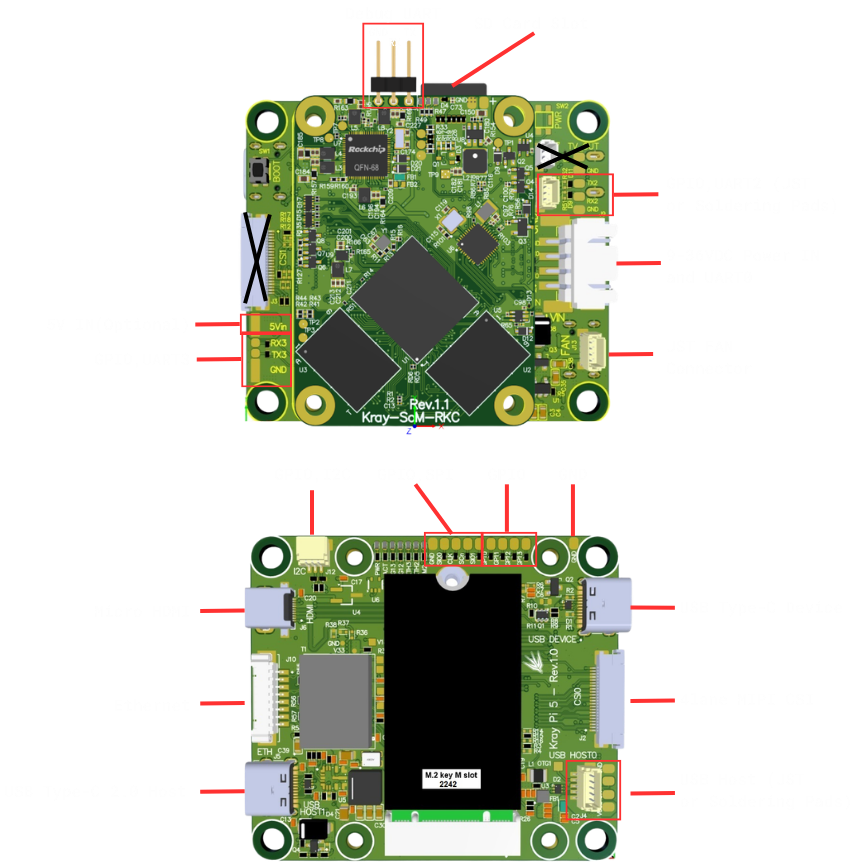
The Kray Pi 5 carrier board for Raspberry Pi Compute Module 5 / 4 is a versatile and high-performance baseboard designed to fully unlock the capabilities of the Raspberry Pi CM5 and CM4. It is compact and lightweight, specifically engineered for use in drones and other compact embedded systems. The board includes all essential interfaces required to connect sensors, cameras, control modules, and other peripherals. Its connectors and mounting holes are designed to match standard drone mounting patterns, enabling fast and convenient integration.

CM4 support mode requires a hardware modification performed at the factory and cannot be changed by the user. In addition, Kray Pi 5 supports CM5 modules with analog video output, expanding display and video device connectivity options.

Thanks to its reliable design and optimized power capabilities, the board is ideal for high-performance, mobile, and autonomous systems where compact size, low weight, and operational stability are critical.

The board provides full compatibility with Raspberry Pi Compute Module 5 for quick system integration. It also supports Hailo module integration, as demonstrated in the product images, enabling rapid hardware acceleration for AI workloads.

With its top and bottom connector layout, the board offers an extended interface panel for cameras, sensors, GPIO, and peripherals, delivering maximum flexibility for professional system integration.

Key Features

—  Universal carrier board for Raspberry Pi CM5 and CM4 (CM4 mode available after factory configuration)
—  Supports CM5 modules with analog video output
—  Compact and lightweight, ideal for drones and embedded systems
—  Includes all essential interfaces for cameras, displays, sensors, and peripherals
—  Connectors and mounting holes compatible with standard drone mounts
—  Designed for high-performance and autonomous solutions with stable power delivery
—  Expandable via M.2 slot for Hailo or NVMe modules

Package Includes
  • Kray Pi 5 carrier board × 1
  • Connection cable set × 1
  • Electronic user manual

Single Board Computer Based on Raspberry Pi Zero 2 W

Kray Pi 2

SoC:

1 GHz quad-core 64-bit Arm Cortex-A53 CPU

Wireless Connectivity:

Wi-Fi 2.4GHz 802.11 b/g/n
Bluetooth 4.2, Bluetooth Low Energy (BLE), onboard antenna

Memory:

512MB SDRAM

Camera Interface:

CSI-2 camera connector

Video Output:

AV (TV Out)
Micro HDMI (one of those active at a time)

Storage:

microSD card slot

Interface for FC:

UART (Connector & Pads for soldering)

USB:

microUSB (Connector & Pads for soldering)

I/O Peripheral:

GPIO (Pads for soldering)

Graphics:

H.264, MPEG-4 decode (1080p30); H.264 encode (1080p30),
OpenGL ES 1.1, 2.0

Power Input:

9V – 28V , 1A max (Connector & Pads for soldering)
or 5V , 1.5A max (Pads for soldering)
(one of those active at a time)

Dimensions:

50 mm x 50 mm

Mounting:

30.5mm x 30.5mm 4 mm hole diameter (same as SpeedyBee stack)

Anticipated price:

32 usd

Dimensions:

50mm х 50mm

Weight:

13 g.

Description

Kray Pi Zero 2W is an ultra-compact and energy-efficient microcomputer based on the Raspberry Pi Zero 2 W chip. Combining low weight, solid performance, and minimal power consumption, it is ideal for drones, robotics, IoT projects, and portable systems. Kray Pi Zero 2W offers stable operation, support for modern interfaces, and broad integration possibilities for both professional and maker-oriented engineering projects.

Its extended peripheral support allows connection of various modules, sensors, and accessories, making it possible to build flexible, functional, and scalable solutions for a wide range of applications.

Package Includes
  • Kray Pi Zero 2W microcomputer × 1
  • Electronic user manual
Key Features

— Based on the high-performance Raspberry Pi Zero 2 W chip
— Compact form factor optimized for drones and mobile applications
— Low power consumption for autonomous systems
— Supports Wi-Fi and Bluetooth
— Compatible with the broad — Raspberry Pi ecosystem of accessories and software
— Suitable for computer vision, automation, and sensor-based applications
— Easy integration into embedded systems via standard interfaces
— Can be powered directly from a UAV battery

Single Board Computer

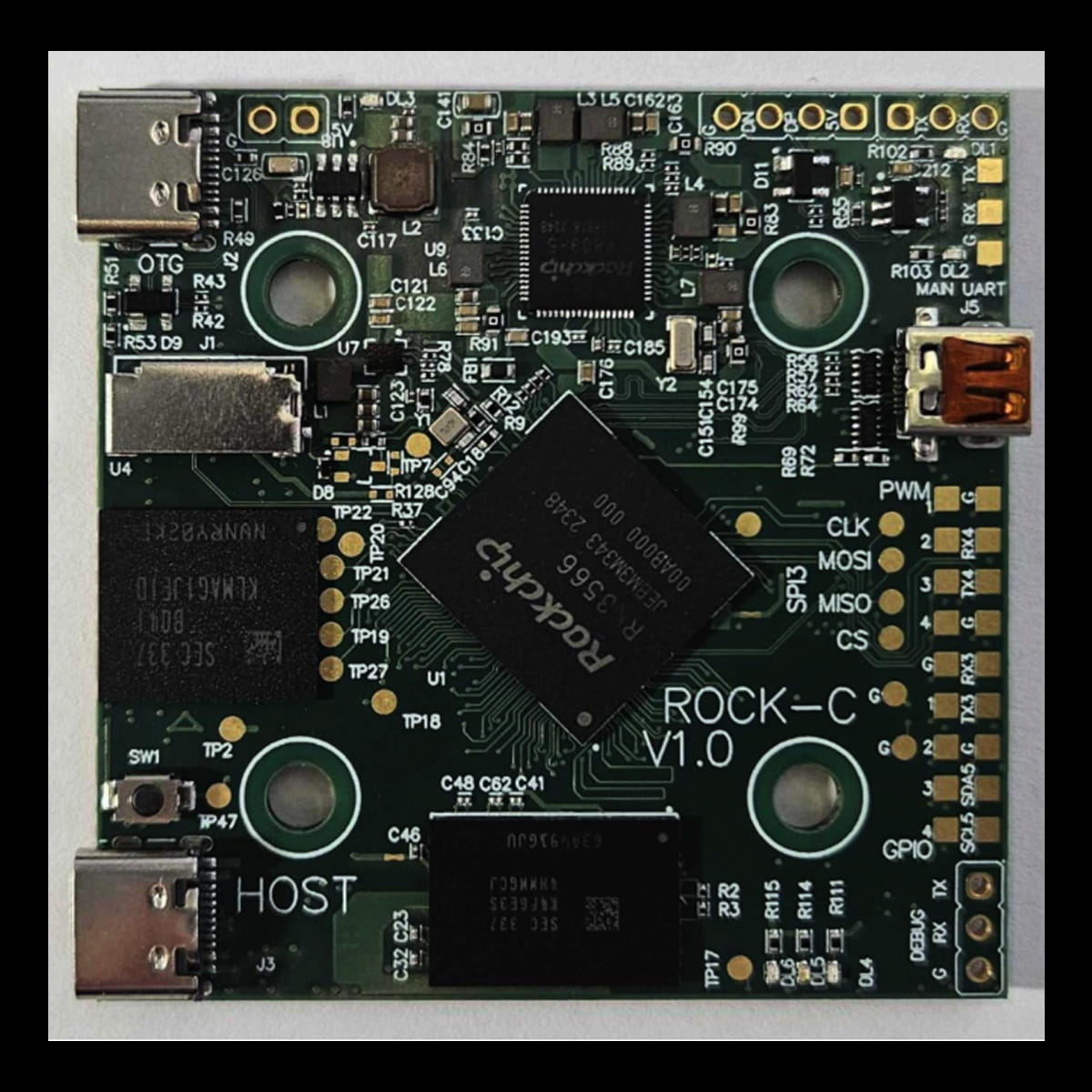
ROCK-C

SoC:

Rockchip RK3566
● CPU: Quad-core ARM Cortex-A55 @ 1.8GHz
● NPU: 1TOPs@INT8
● GPU: ARMG52-2EE

Memory:

2 GBytes LPDDR4

Storage:

● Onboard eMMC 16 GBytes
● microSD (TF) card holder

Display interface:

Micro HDMI connector

Camera interface:

● External AV-USB converter for analogue camera
● CSI connector for digital camera

USB:

● USB 2.0 Host at T ype-C connector
● USB 2.0 Host at soldering pads
● USB OTG T ype-C connector for SoC flashing

I/O peripheral:

● up to 4 x UART
● up to 2 x I2C
● SPI
● up to 6 PWM outputs
● 4 x GPIO
● 3 x status LED indicators

Mounting:

30.5 x 30.5 mm( 4 mm hole diameter)

Dimension:

55 x 55 mm

Power input:

5V (soldering pads or USB OTG)

Description

ROCK-C is a compact single board computer based on the Rockchip RK3566, designed for direct integration into drones, robotics, and other embedded systems. It is equipped with a quad-core ARM Cortex-A55, 2 GB LPDDR4, and 16 GB eMMC, providing sufficient performance for peripheral control, sensor integration, video processing, and lightweight AI on-board.

The board supports camera and display connectivity, making it suitable for FPV, computer vision, local image analysis, and autonomous logic execution without постоянного cloud connectivity. With interfaces such as UART, I2C, SPI, GPIO, PWM, and LEDs, ROCK-C can be easily integrated with flight controllers, sensors, communication modules, and other peripherals. This makes it a practical platform for edge computing on UAVs and systems operating in offline or connectivity-constrained environments.

Raspberry Pi Compute Modules

Technical Specifications

Technical specifications vary depending on the specific Compute Module generation and configuration.

Description

Raspberry Pi Compute Module is a family of compact compute modules designed for integration into custom embedded systems, edge devices, and industrial products. They combine the performance of Raspberry Pi with a more flexible form factor suitable for OEM development.

Depending on the model, these modules feature Arm processors, different configurations of RAM and eMMC storage, and support for Ethernet, Wi-Fi, Bluetooth, as well as camera, display, and peripheral connectivity through a wide range of interfaces. Multiple variants are available, including Lite versions without onboard storage.

This makes the Raspberry Pi Compute Module line a versatile platform for building custom hardware solutions with a strong balance of performance, energy efficiency, and integration flexibility.

Edge on the battlefield